
Driveway & Pavers: Repair or Replace? How Fort Worth Homeowners Decide
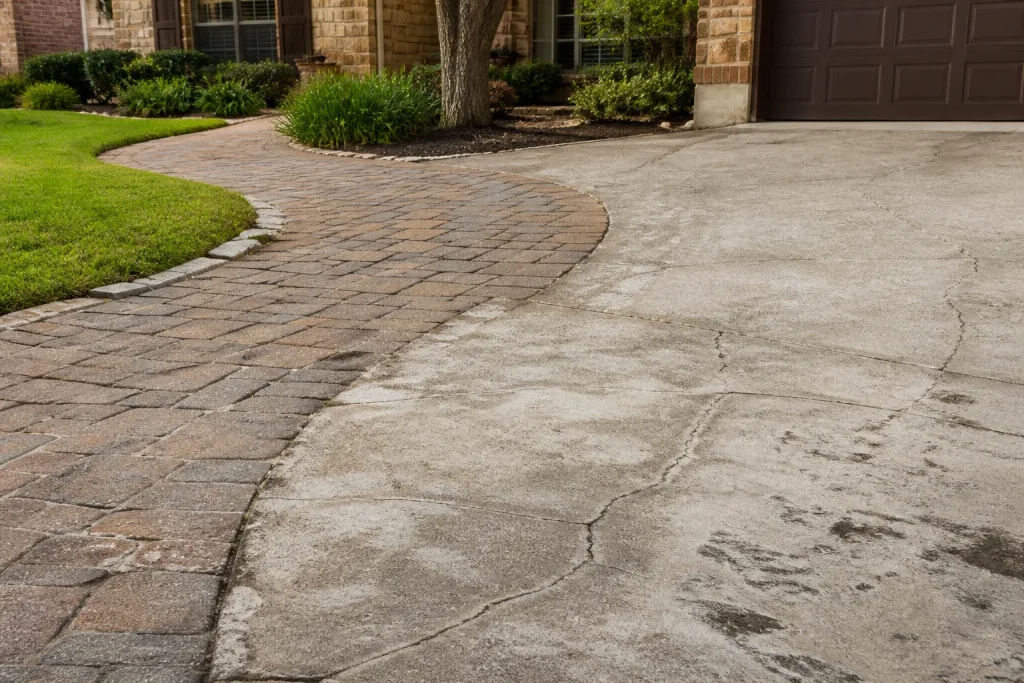
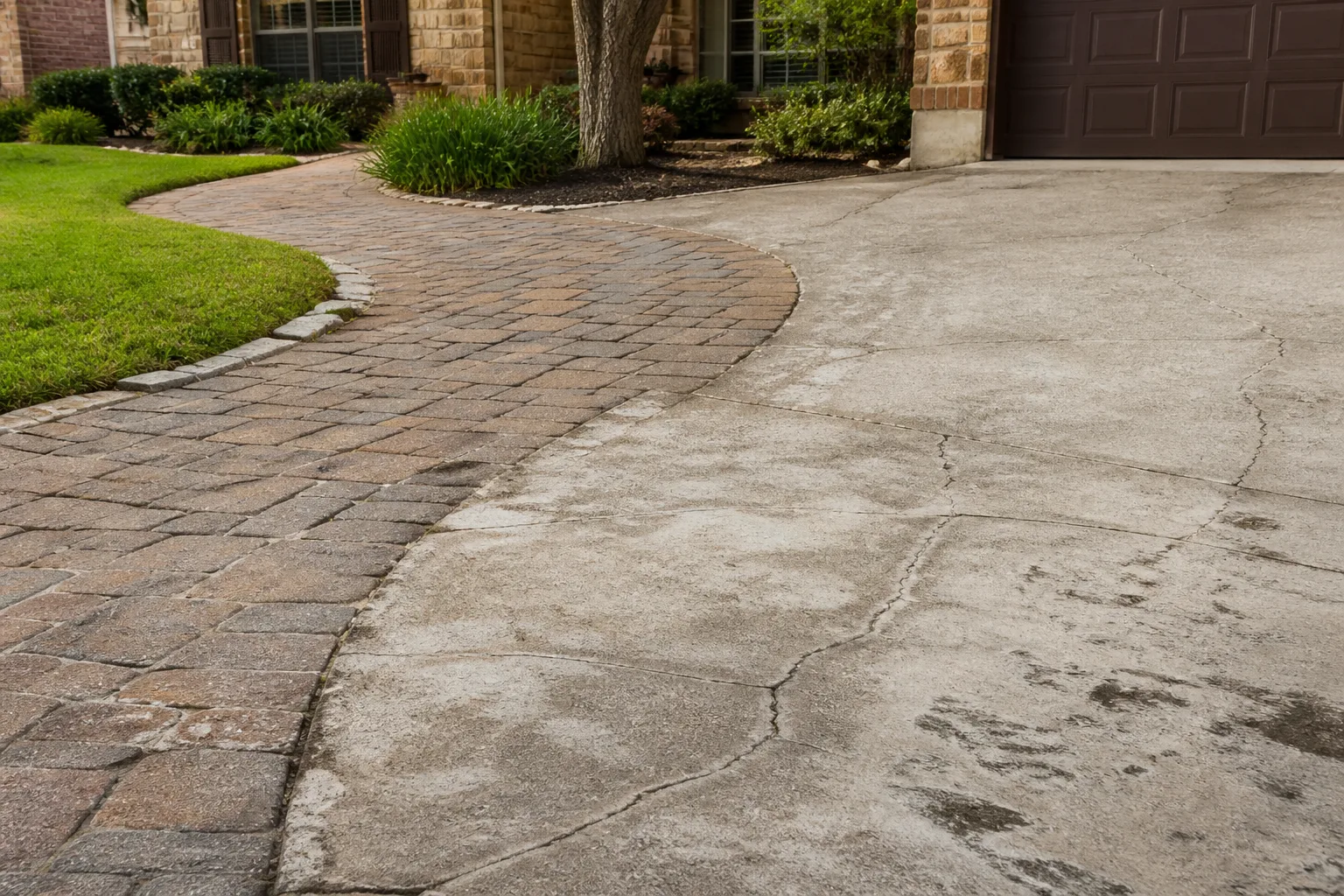
Most Fort Worth homeowners make the repair-or-replace call by eyeballing the surface. That’s the wrong metric. A paver driveway with 30% sunken or cracked units can cost less to fix than one with 10% surface damage, if that second driveway has a failed subbase underneath. The number of bad pavers tells you almost nothing. The condition of the base tells you everything.
What’s the difference between surface failure and subbase failure?
Two driveways can look similar from the street and need completely different work. This is the distinction that decides the whole question, and it’s the first thing we assess on any driveway in Fort Worth.
Surface failure indicators (repair is usually the right call):
- Individual pavers cracking or chipping while their neighbors stay tight and level
- Joint sand washing out along the edges or in a single low spot
- Edge loss where the driveway meets the street or a landscape bed
- Isolated staining or efflorescence, which signal wear, not structural movement
Subbase failure indicators (repair cost climbs fast):
- A widespread settlement pattern: pavers stepping down together across a whole section, not one bad unit
- Pavers that rock underfoot, or the whole section shifting when you walk across it
- Joint erosion that keeps coming back after earlier repairs
- The same sinking spot reappearing within one or two seasons of being fixed
When we see isolated cracking, we’re looking at a maintenance problem. When we see pavers rocking across a section in a Fort Worth driveway, we’re looking at a base that has lost its load transfer. Sand and leveling will buy a season. It won’t fix the cause.
Why Fort Worth clay soil makes this harder than it looks
Tarrant County sits on expansive clay soil, and that clay drives most of the failure patterns we see. Clay swells when it takes on water and shrinks as it dries. Across a Fort Worth summer, that means seasonal heave in the wet weeks and settlement in the dry ones, over and over.
For the first few years this movement reads as normal aging. Pavers settle a little, joints open slightly, nothing dramatic. But the pattern matters. A driveway that dips in the same zone every spring and fall isn’t aging normally. It’s telling you the subbase wasn’t built to handle that expansion. When water finds a low spot and sits there, the clay under the edge softens, the base material migrates, and a section loses support. That’s when surface repair becomes money paid twice.
We’ve pulled up problematic sections in neighborhoods like Tanglewood and Arlington Heights where the pavers themselves were fine and the base was the whole story: washed-out bedding sand, a compacted layer that had never been deep enough, and clay that had been moving for years. New pavers on that same base would have failed the same way within a season or two.
One detail worth knowing before you pour a single bag of anything: soil conditions and drainage requirements vary by property, so any base decision should be based on what’s actually under your driveway, not a generic rule of thumb.
At what point does repair cost as much as replacement?
This is the crossover math homeowners actually want. Here are typical Fort Worth figures, and the percentage where repair stops making sense.
| Scope | Typical Fort Worth cost | When it’s the right call |
|---|---|---|
| Spot repair (reset and re-sand a few units, single low area) | $300 – $900 | Under about 10% of the surface, base intact |
| Section repair (lift, re-level, replace base material in one area) | $1,200 – $3,500 | 10 – 25% of the surface, cause identified and addressed |
| Full re-lay on existing pavers with new base | $6 – $11 per sq ft | Pavers reusable, 25 – 40% damage, base rebuild needed |
| Full replacement, new pavers and base | $12 – $22 per sq ft | Over 40% damage, or pavers too worn or broken to reuse |
The rule of thumb: once repair estimates climb past roughly half the cost of a full replacement, replacement usually wins. A 400 square foot section repair at $2,500 on a 1,000 square foot driveway is often worth doing. The same $2,500 spent on a driveway already showing 35% damage across multiple zones is money you’ll spend again in a few years.
Does the age of the driveway and the original install change the answer?
Two driveways can look identical and carry very different value. What matters is not the number on the calendar, but whether the base was built correctly the first time.
A 10-year-old driveway installed to spec, now showing 20% surface damage, is usually a repair candidate. The base was compacted, the edge restraint was set properly, and the damage is likely localized. Fix the cause in that section and the rest of the driveway holds.
A 5-year-old driveway installed on the cheap, showing the same 20%, often isn’t worth repairing. If the base was thin, poorly compacted, or the drainage slope was never right, you’re repairing a symptom on top of a defect. That’s the driveway most likely to have you back at the same conversation in three years.
When we look at a driveway in Fort Worth, we check edge restraint, drainage slope, and how the base sounds under a probe before we quote anything. If the pavers are solid and the base isn’t, the honest recommendation might be to lift and re-lay rather than replace. That’s a conversation worth having before a driveway is torn out.
What should you ask a contractor before accepting a repair bid?
A repair quote can be perfectly honest and still solve the wrong problem. Ask these before you sign.
- Will this repair address the cause or only the surface? A contractor who can name the cause (poor drainage, shallow base, failed edge restraint) can tell you why it will or won’t hold.
- What will you put in writing about how long this repair should last? Get an expected lifespan in the quote, not a verbal promise.
- Are you replacing base material or just re-sanding? These are different jobs with different prices, and only one addresses movement.
- What’s the drainage plan for this section? If water pools in the same spot, no repair will last.
When to call a pro: if you’re seeing pavers rock across a whole section, or a repair keeps failing, get a qualified paver contractor to assess the base before you spend again. Under Clause 1 of our Haven Standard, that means a written price and written scope before anyone picks up a tool, so you can compare bids on the same sheet of paper.
Related services in Fort Worth: if you’re updating the whole front of the property at the same time, take a look at Driveway & Pavers in Fort Worth, Fence Installation in Fort Worth, and Home Additions & ADU in Fort Worth. You can also start at our Rowan Construction Group Fort Worth home page.
The Bottom Line
Repair versus replace on a Fort Worth paver driveway comes down to one question: is the base still sound? Surface cracking, joint sand loss, and isolated edge damage are usually repairs. Widespread settlement, rocking pavers, and sinking that keeps coming back are base problems, and those get expensive fast. Watch the math: once repair hits roughly half the cost of replacement, or damage passes 40% of the surface, replacement often wins. Get the cause named in writing, not just the fix.
If you’re in Fort Worth and aren’t sure which category your driveway falls into, Rowan Construction Group Fort Worth offers free estimates – call (833) 570-6084. We’ll show you what we found and put the price in writing before any work starts. Bring a competitor’s bid and we’ll review it line by line as a free second opinion. Our technicians have up to 19 years of experience, and every visit includes a documented photo record as standard.
Frequently Asked Questions
Spot repairs typically run $300 – $900, and section repairs that address the base run $1,200 – $3,500, depending on size and access. Replacement runs $12 – $22 per square foot. Call (833) 570-6084 for an exact quote – estimates are free.
No. Under our Haven Standard, the price is written before anyone starts, and no change proceeds without a signed change order. If we uncover something unexpected, we stop and put it in writing first. Call (833) 570-6084 to schedule a free estimate.
Often, yes. If the pavers themselves are sound and the failure is in the base or drainage, lifting and re-laying on a rebuilt base can cost 30 – 50% less than full replacement. The pavers have to be intact enough to reuse. Call (833) 570-6084 and we’ll tell you honestly which applies.
Look for pavers rocking across a section, a settlement pattern that repeats in the same zone, or a repair that failed within a season or two. Any of those means the base, not the surface, needs attention. Call (833) 570-6084 for a free assessment.
Written by the team at Rowan Construction Group Fort Worth.
Need Construction Help?
Call Rowan Construction Group Fort Worth - licensed & insured, here with fast after-hours help in Fort Worth.
(833) 570-6084