
5 Mistakes to Avoid With Driveway & Pavers
The most expensive paver mistake in Fort Worth isn’t choosing the wrong style. It’s installing the right pavers over a subbase that wasn’t deep enough to get below the clay expansion layer, a shortcut that costs roughly $12 – $18 per square foot to correct after the fact. Four of the five mistakes below happen underground before a single paver is set, which is exactly why homeowners don’t discover them until the driveway starts shifting years later. If you’d rather not gamble on what’s buried under your driveway, call (833) 570-6084 and we’ll talk through what a correct install actually requires.
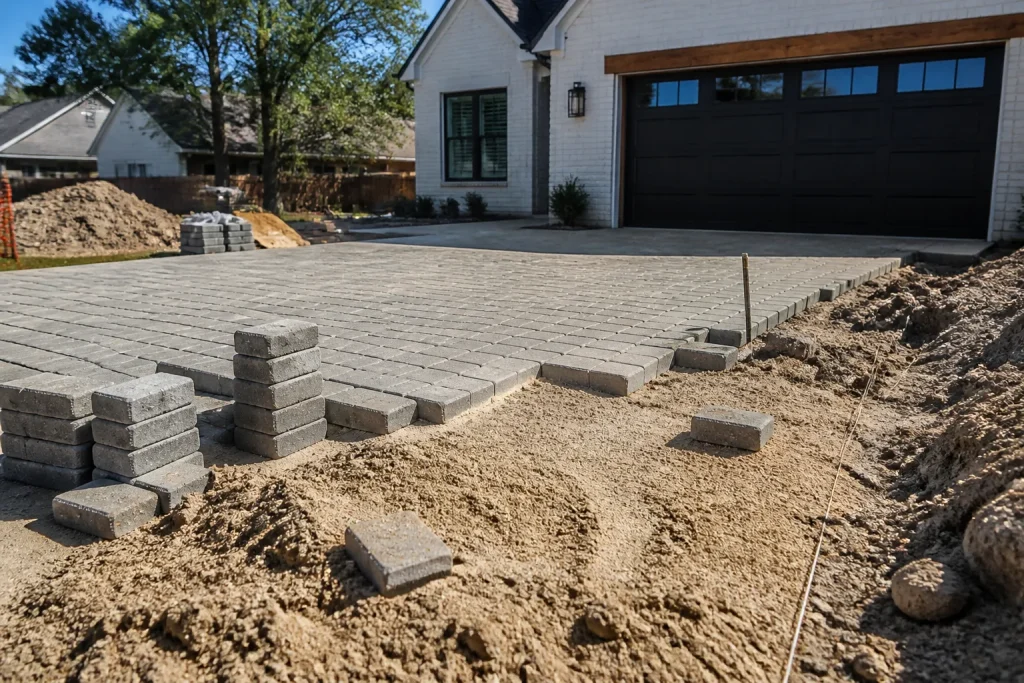
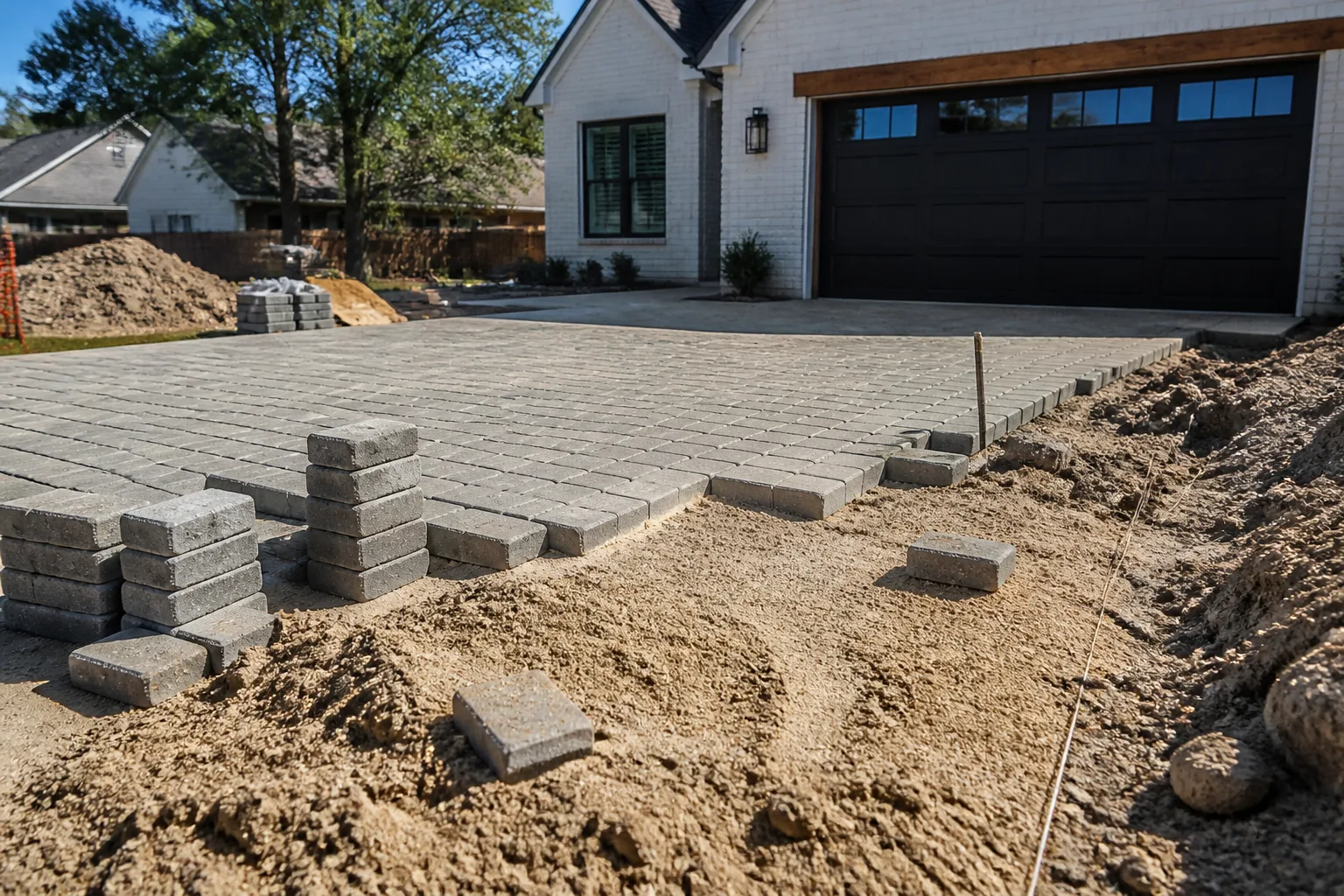
Here’s what we mean by “underground.” A paver driveway is a layered system: compacted native soil, then a geotextile fabric in many cases, then a deep bed of compacted aggregate base, then a thin bedding course of sand, then the pavers, then joint sand, held at the perimeter by edge restraints. Every one of the five mistakes below breaks that system at a different layer. None of them show up on the day of installation. All of them show up later, usually as a dip at the garage apron, a ripple across the field, or a paver that rocks when you walk on it.
Mistake 1: A Base That’s Too Shallow for Fort Worth’s Clay
Fort Worth sits on expansive clay soil, and that clay moves with moisture. It swells when it’s wet and shrinks when it dries, and a driveway built over a base that doesn’t extend below the active zone will move with it. The minimum compacted aggregate depth for a stable residential driveway is generally 6 to 8 inches, and in Fort Worth’s clay we often specify toward the deeper end of that range. Budget installers routinely pour 3 to 4 inches because aggregate is the most expensive line item they can cut without the homeowner noticing on day one.
The dollar difference is real. Going from a 4-inch base to a 7-inch base adds roughly $6 to $10 per square foot in material and compaction labor on a typical Fort Worth driveway. Correcting a failed shallow base later, which means tearing out the pavers, excavating, re-grading, and reinstalling, runs $12 – $18 per square foot. The cheap install isn’t cheaper. It just moves the bill.
What to ask before you sign: how many inches of compacted base, what aggregate spec (crushed stone with fines, not pea gravel), and how many compaction passes per lift. A contractor who can’t answer those three questions in writing hasn’t planned the job.
Mistake 2: Skipping or Underspecifying Edge Restraints
Pavers are held in place by the field pressing against itself, and the field is held by the perimeter. Without properly pinned edge restraints, the whole field migrates outward, one paver at a time. This is the mistake that hides the longest, because the driveway looks perfect for the first year or two.
What it looks like over time, in our experience across Fort Worth:
- Year two: a hairline gap opens along the driveway edge where pavers have crept toward the lawn or street. Easy to ignore. That’s the problem.
- Year four: the joint sand has washed out of the migrating edge, weeds colonize the gap, and the outermost row starts rocking when you walk on it.
- Year six: the outer courses have shifted enough that the driveway no longer meets the garage apron or the sidewalk cleanly, and the fix is no longer a repair, it’s a rebuild of the perimeter.
Correct edge restraint is a rigid, spiked or pinned profile set in a concrete haunch, not plastic edging staked with landscape spikes. On a Fort Worth driveway we specify restraint on every exposed edge, including the apron transition. Ask your installer what restraint is being used and how it’s anchored.
Mistake 3: Wrong Jointing Sand, Applied at the Wrong Time
Polymeric sand is the right choice for most Fort Worth driveways, but only if it’s applied inside its working window. Polymeric sand sets when it’s activated with water, and in Fort Worth’s summer heat the surface can be too hot for the water to penetrate evenly before the sand skins over. The recommended window is generally when surface temperatures are below about 90 degrees and there’s no rain in the forecast for 24 hours. Miss that window and the sand cures unevenly, leaving soft spots that wash out in the first hard rain.
The other version of this mistake is using plain mason sand in the joints. Plain sand works fine on a patio under a roof. On a driveway exposed to Fort Worth rain and runoff, it erodes out of the joints within a season, and once the joints are empty the pavers lose their interlock and start to shift. Silestone and Caesarstone have nothing to do with joints, they’re countertop brands, but the principle is the same: the material you choose for the layer matters as much as the visible surface.
Ask what sand is specified, how it’s installed dry or wet, and what the surface temperature policy is. A contractor who’s installed pavers in Fort Worth in August knows this answer cold.
Mistake 4: One Compaction Pass Where There Should Be Several
Compaction is where the invisible work happens, and it’s the easiest step to shortcut because nobody sees it. A correct base compaction follows a sequence: aggregate placed in lifts of no more than 4 inches, each lift watered to near-optimum moisture and compacted with a plate or vibratory roller, multiple passes in overlapping directions until the surface refuses to move. A shortcut is a single pass with a plate compactor over a thick lift, which looks compacted on top and stays loose underneath.
We’ve pulled pavers out of a driveway in the Ridglea area where the base had been placed as one 9-inch lift and compacted twice. The top two inches were rock hard. The bottom seven were still loose. The pavers above were fine; the surface beneath them was a sponge, and every rain pushed water into it until the whole field started to settle.
Documentation matters here. Ask for a photo record of the base before the bedding sand goes down, showing depth against a tape and the compaction equipment used. Every visit at Rowan includes a documented photo record as a standard deliverable, so you have evidence of what was found and what was done, not a verbal promise that it was done right.
Mistake 5: No Drainage Plan, Just a “Flat” Driveway
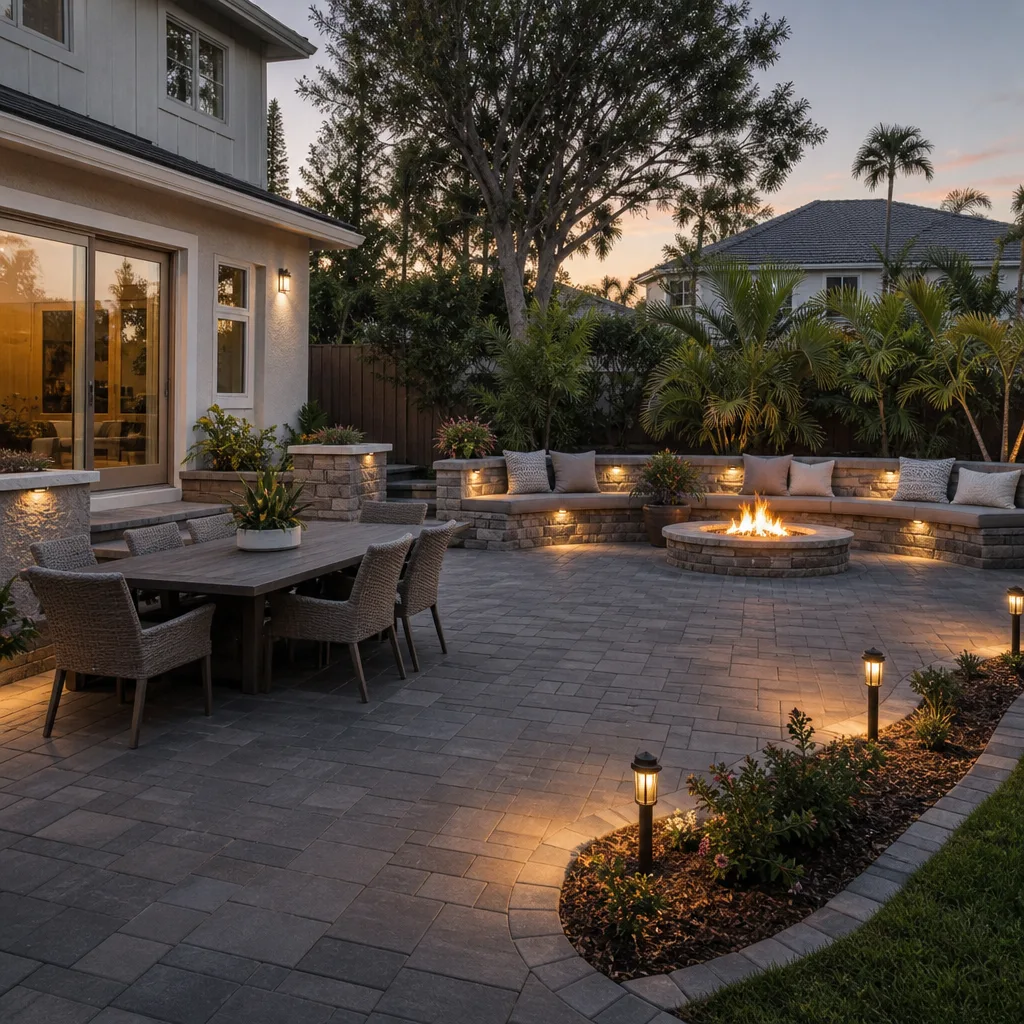
Fort Worth is flat, and flat ground doesn’t drain by itself. A paver driveway needs deliberate slope, typically a minimum of 1 to 2 percent away from the house and toward a discharge point, and sometimes a channel drain at the garage apron or a swale at the low side. Skip the slope and you don’t get a water problem in year one. You get a subbase problem in year three, because water that ponds on the pavers finds its way into the joints and down into the base, and the base loses bearing capacity inch by inch.
The drainage design also has to account for what happens to the water once it leaves the driveway. In older Fort Worth neighborhoods the storm drain may be undersized, and a driveway that discharges onto a neighbor’s yard is its own problem. Ask where the water goes. The answer should be specific, not “it drains away.”
These five mistakes are the reason we link driveway and paver work to roofing and fencing in our own project planning, since water that leaves one surface becomes a problem for the next. If you’re adding a fence or planning a home addition alongside the driveway, it pays to design them together. You can see our Driveway & Pavers in Fort Worth page for more detail on how we spec the work, and if the driveway shares a property line with a new fence, our Fence Installation in Fort Worth team is worth a call too.
When to Call a Pro
If your paver field has started to rock underfoot, if the joints are washing out after every storm, or if you’re within a year of an install and something already looks wrong, call a professional. Correcting a subbase failure is excavation work with heavy equipment, and it’s not a weekend job. If you’re planning a driveway install or a driveway-plus-addition project, our Home Additions & ADU in Fort Worth team coordinates the site work so the driveway and the building footprint are graded against the same plan, not two separate ones.
Related Services in Fort Worth
Rowan Construction Group handles seven residential trades, and driveway and paver work sits alongside the rest. If you want the full picture of how we work, our Rowan Construction Group Fort Worth home page spells out the Haven Standard, including the rule that the price is written before any work starts.
What happens when you call
- 1
A real person answersNo phone trees – you reach a local pro.
- 2
You get an upfront price rangeHonest numbers before anyone is dispatched.
- 3
A background-checked tech heads outLicensed & insured, dispatched right away.
- 4
You approve before work beginsNothing starts until you say go.
The Bottom Line
Four of the five mistakes above are invisible on the day you hand over the check, and all four live in the base, the restraint, the compaction, and the drainage. The fifth, joint sand, is visible within a season. The common thread is that a paver driveway is only as good as the layers beneath the pavers. Budget installers cut base depth first because aggregate is the line item homeowners can’t see. Ask for depth in inches, restraint detail, compaction documentation, and a drainage plan in writing before anyone picks up a shovel. If you’re in Fort Worth and want that kind of documentation before you commit, Rowan Construction Group Fort Worth offers free estimates, a written price before any work starts, and a free second opinion on any written estimate you already have. Call (833) 570-6084 to schedule yours.
Frequently Asked Questions
Generally 6 to 8 inches of compacted crushed aggregate, and in Fort Worth’s expansive clay we often lean toward the deeper end of that range so the base extends below the active clay layer that swells and shrinks with moisture. Anything under 5 inches is a shortcut. Call (833) 570-6084 if you want your current estimate reviewed against that number, and we’ll look at it line by line for free.
At Rowan no work proceeds on a change until a signed change order is in place, so the price you agreed to is the price unless you sign for a change. That’s the discipline that’s kept our projects within a few percent of the agreed cost across 4,000-plus jobs. Call (833) 570-6084 for an exact quote, estimates are free.
A typical residential driveway runs about three to five working days from excavation to final joint sand, weather permitting, with the base compaction on day one and two doing the heavy lifting. Larger drives or ones needing a channel drain can stretch to a week. Call (833) 570-6084 and we’ll give you a realistic schedule in writing with the estimate.
Yes, and it’s one of the more common driveway calls we get in Fort Worth. We’ll assess the base, restraint, and drainage, and give you a written scope showing what needs to come out and what can stay. Bring us the original installer’s written quote and we’ll review it line by line as a free second opinion. Call (833) 570-6084 to set up the visit.
Written by the team at Rowan Construction Group Fort Worth.
Need Construction Help?
Call Rowan Construction Group Fort Worth - licensed & insured, here with fast after-hours help in Fort Worth.
(833) 570-6084