Last updated November 18, 2026


Free written scope consultation - allowances, timeline, and change-order rules on paper before a single trade is scheduled
Driveway & Pavers Warning Signs Every Homeowner Should Know
A quarter-inch gap opening between your edge pavers and the lawn border is not a cosmetic flaw. It is the visible symptom of edge restraint failure, and in Fort Worth’s wet spring season that small opening can turn into a full base washout within 60 to 90 days. We’ve watched the same driveway go from a $300 re-sanding job in April to a $4,000 base reconstruction by July because nobody read the sign early. This guide names five warning signs, gives you the measurement thresholds that separate “wait” from “call now,” and explains how Fort Worth’s climate changes how fast each one escalates.
Quick Answer
Watch for five visible conditions on a paver driveway: joint gaps wider than 1/4 inch, pavers that rock underfoot, low spots that hold water, white efflorescence staining, and edge pavers shifting away from their border. Each one maps to a specific failure – joint sand loss, base settlement, drainage failure, water infiltration, or edge restraint breakdown – and each has a repair window measured in weeks, not years. Miss the window and a few-hundred-dollar fix becomes a four-figure base rebuild.
Styles & brands we work with
- Kitchen remodeling
- Bathroom remodeling
- Home additions & ADU
- Roofing
- Windows & doors
- Driveway & pavers
- Fence
Table of Contents
- Warning Sign 1: Joint Gaps That Keep Widening
- Warning Sign 2: Pavers That Rock Underfoot
- Warning Sign 3: Low Spots That Hold Water
- Warning Sign 4: Efflorescence and White Staining
- Warning Sign 5: Edge Paver Migration
- The Straight-Edge Test: Measuring Base Failure
- Why Fort Worth’s Seasons Change the Urgency
- How to Photograph and Measure Over 30 Days
- Contractor Behaviors During Installation That Predict Future Problems
Warning Sign 1: Joint Gaps That Keep Widening
Joint sand is the mortar of a paver driveway. It locks each unit in place and keeps water from reaching the base underneath. When sand washes out, gaps open, and the gap width tells you how far the failure has progressed.
- Under 1/4 inch: normal seasonal movement. Re-sand with polymeric joint sand and monitor.
- Over 1/4 inch: the sand has washed out faster than it can be replaced. Re-sanding is now a repair, not maintenance, and you need to find out where the water is going.
- Over 1/2 inch: edge restraint inspection is mandatory. Gaps this wide usually mean water is running under the field and the edge has lost its anchor.
Grab a caliper or a set of drill bits in 1/8-inch increments and check gaps at the edge, at the middle of the driveway, and along the garage apron. If the gaps are widest at the edges, you’re looking at an edge problem. If they’re widest in the middle, the base is settling under the load of your vehicles. On older Fort Worth driveways in neighborhoods like Ridglea Hills and Arlington Heights, we regularly see this pattern begin on the sun-exposed south side first, because thermal expansion pushes pavers toward the shade and squeezes sand out of the joints.
Warning Sign 2: Pavers That Rock Underfoot
Rocking is the single most reliable early signal of base failure, and where it happens tells you what’s failing.
A single paver rocks: that unit has lost its bedding sand. Usually a local fix – lift, re-level, reset, re-sand. Cost stays in the low hundreds.
A pattern of pavers rocks: the base itself has settled or lost compaction. This is not a re-set job. You’re looking at lifting a section, re-grading the base, and recompacting – which runs into four figures depending on the square footage.
Test it in healthy shoes, not bare feet. Walk the length of the driveway and press the heel of your hand on the corners of suspect pavers. A paver that moves more than a millimeter at the corner is loose. Mark the loose units with chalk and check again in two weeks. If the marked area has grown, the base is moving and the problem is active. We’ve found that driveways installed with a low-plasticity base material – common in budget work around Fort Worth’s older subdivisions – develop pattern rocking within three to five years of installation, usually after a wet spring pushes the fines down into the subgrade.
Warning Sign 3: Low Spots That Hold Water
Pavers should drain. A driveway that holds a puddle more than 24 hours after rain has a slope problem, a base settlement problem, or both – and they call for different fixes.
Here’s the distinction that matters: drainage failure means the driveway was built flat or pitched toward the house or garage. Water pools because there is nowhere for it to go. That’s a design correction and, honestly, the more expensive diagnosis. Base settlement means the surface was pitched correctly but a section of base has collapsed under a low spot. Water finds the lowest point, so a settlement bowl looks like a drainage problem until you put a level on it.
Lay a 4-foot straightedge across the low spot in both directions. If the surface reads flat, the issue is drainage design. If the straightedge shows a visible dip under one end, that’s settlement. Puddles that hold more than 1/4 inch of standing water for more than 24 hours invite mosquito breeding and accelerate joint sand loss from below. In Fort Worth, where summer thunderstorms drop an inch in an hour on a regular basis, a settlement bowl that started at 1/8 inch deep can be a 1-inch pond by the following July.
Warning Sign 4: Efflorescence and White Staining
Efflorescence is the chalky white bloom you see on concrete and clay pavers – mineral salts carried to the surface by water and left behind when the water evaporates. Not every white stain is a problem, but it’s never random.
Cosmetic efflorescence: a light, powdery haze that appears after a wet season, wipes off with a stiff brush, and doesn’t return within a month. Clean it and move on. On Tamko and Boral paver products, a small amount of surface bloom in the first year after install is normal curing behavior.
Diagnostic efflorescence: a heavy, crusty bloom that returns after every rain, or that appears in one specific patch rather than across the whole surface. That pattern means water is traveling through the pavers from underneath – a sign of base saturation or a broken drain line weeping under the field. The salt is the messenger. The water is the problem.
Don’t reach for a pressure washer on the first attempt. High-pressure washing drives water into the joints and worsens both sand loss and salt movement. Start with a dry brush and a mild efflorescence cleaner, then watch whether the patch returns within four weeks. A stain that keeps coming back in the same spot is telling you something underneath needs opening up.
Warning Sign 5: Edge Paver Migration
Edge pavers should be pinned in place by a rigid edge restraint – a concrete or aluminum curb that locks the field into position. When pavers at the perimeter start creeping outward, the restraint has failed and the base is one rainstorm away from washing out.
Measure the gap at the most exposed corner of the driveway, where the pavers meet the lawn or the curb. A gap opening wider than 1/4 inch over a single season, or any gap that has visibly widened month over month, is a restraint failure. If you can slide a screwdriver blade under the edge pavers and lift them a quarter inch, the restraint has lost its grip entirely.
This is where Fort Worth’s climate does real damage. Spring rain soaks the base along the open edge, and summer heat drives water off quickly, and the cycle repeats. Every cycle moves sand and fines, and the edge paver – unprotected by neighboring units on one side – walks itself loose. In our experience, the driveways in Fort Worth with the shortest time between “first gap” and “base washout” are the ones without a specified edge restraint at all. That omission is usually visible if you read the original installation contract, and if there wasn’t one specified, the warning signs you see now started on day one.
The Straight-Edge Test: Measuring Base Failure
You don’t need special tools to find out whether a paver problem is cosmetic or structural. A 4-foot level or straightedge and a tape measure will do it.
- Pick a flat-feeling section as your reference. Set the straightedge across 4 feet of pavers that feel solid and confirm both ends are in contact with the surface.
- Move the straightedge over the suspect area. Set one end on solid pavers, the other end on the suspect paver.
- Measure any deflection at the corner. Slide a tape measure or feeler gauge under the corner of the suspect paver. Anything over 1/8 inch is early warning. Over 1/4 inch of deflection across a 4-foot span indicates base failure and warrants a professional assessment before another rainy season.
- Repeat in three directions – lengthwise, crosswise, and along the edge – because the failing strip often hides under an otherwise sound surface.
Record each measurement with a date. One reading is anecdote; three readings over a month is data. When you hand a contractor a photo with a measurement and a date, the diagnosis takes minutes instead of an hour.
Why Fort Worth’s Seasons Change the Urgency
The same warning sign carries very different urgency depending on the month it appears. The seasonal calendar below is Fort Worth-specific, and it changes what “act now” means.
- April and May (rain infiltration): North Texas fronts drop several inches of rain in short bursts and the ground saturates. A joint gap that opens in April is actively taking on water. If it’s over 1/4 inch, re-sand within two weeks or the base starts washing under it.
- June through August (drought shrinkage): Fort Worth summers bake the soil, and clay-rich subgrades shrink and pull away from the base. Joint gaps that appear in July and close by September are usually summer shrinkage, not failure – measure before you panic. But the same shrinkage opens up new plumbing leaks and loosens edge restraints, so a gap that doesn’t close by mid-October is a genuine problem.
- September and October (the recovery window): the best time of year in Fort Worth to re-sand, reset loose pavers, and rebuild edge restraint before the next wet cycle.
- Winter (freeze-thaw spalling): rare in Fort Worth, but the occasional hard freeze on saturated pavers pops faces and cracks joints. Catching saturation in November prevents winter spalling in January.
Our crews in Fort Worth see the same pattern every year: the calls about edge failure that come in July were mostly set in motion by a joint gap that opened in April and didn’t get re-sanded. If you own a driveway in a Fort Worth neighborhood with heavy clay subgrade, treat every April re-sand as cheap insurance against a July base washout.
How to Photograph and Measure Over 30 Days
“The driveway looks bad” gives a contractor nothing. A dated measurement, a photo, and a 30-day log give them a diagnosis. The documentation protocol takes about 10 minutes a week and shorts the entire conversation.
- Shoot the same frame every time. Place a fixed object (a paver edge, the garage apron corner, a utility box) at the left of the image and shoot the problem from the same standing spot. Cell phone camera, wide angle, mid-morning light.
- Add a scale. Lay a tape measure or a 4-foot straightedge next to the gap, low spot, or loose edge paver. A photo with a scale in it is evidence; a photo without one is confusion.
- Record the measurement on the frame. Write the number and date in your phone notes, or on a slip of paper visible in the photo. Gaps, deflection, and standing water depth – measure what’s visible.
- Repeat weekly for four weeks. Same frame, same measure, same time of day. Change in that window is the key finding: a gap that moves 1/8 inch in 30 days is active, a gap that stays flat is stable.
- Log after rain. Shoot the low spot 24 hours after every meaningful rain. Standing water at 24 hours is a threshold; water gone in 12 hours is normal.
Bring this log to the estimate. A contractor looking at 30 days of measurements can quote the repair with real confidence, and the quote you get back is more honest because the diagnosis isn’t guesswork.
Contractor Behaviors During Installation That Predict Future Problems
Most failing driveways we inspect were failing on installation day. The warning signs in a contractor’s own process are the earliest indicators you’ll ever get.
- No compaction testing during base install. Base compaction is the whole foundation of a paver driveway. A contractor who doesn’t test compaction (with a density test, not a visual check) is gambling with your driveway’s life. The failure shows up years later, in rocking and settlement.
- No edge restraint specified in the written contract. Ask to see the exact edge product named in the contract – concrete curb, aluminum edge, or similar. If the contract is silent on edge restraint, it will be the first thing to fail.
- Joint sand applied during rain or on wet pavers. Polymeric sand applied to a wet surface cures into a weak crust that fails within one season. It should go on a dry surface, in dry weather, and be watered in after the install according to the manufacturer’s instructions.
- Base thickness left to chance. The contract should name the compacted base depth (typically 6 to 8 inches of compacted aggregate for a residential driveway). If it doesn’t, you’re buying a paver surface over an unknown foundation.
- No allowance for drainage slope in the plan. Water has to leave the driveway. The plan should show a slope away from the house and garage – usually at least 1.5% – and if it doesn’t, low spots are in your future.
When we quote a Driveway & Pavers in Fort Worth project, the written scope names the brand, the base depth, the edge restraint product, and the compaction standard before anyone picks up a tool. That works because the plan is written first, not improvised. If you’re choosing pavers for a new installation, this guide to driveway pavers in Fort Worth goes deeper on brands like Belgard and Techo-Bloc and what the genuine price range looks like in the local market.
Common Mistakes to Avoid
- Treating joint gaps as cosmetic. A quarter-inch gap is not a color issue, it’s a water entry point. Every rain after that point starts damaging the base, and Fort Worth’s spring rain is aggressive about it.
- Pressure-washing before diagnosing. High-pressure water drives loose sand deeper into the joints and worsens settlement. Clean the efflorescence first, then diagnose the sand loss.
- Adding pavers without checking the restraint. If you’re expanding a driveway, the new section needs its own edge restraint anchored to the base. Adding pavers over an unreinforced edge means the whole field is now one failure away from washout.
- Re-sanding without fixing the water source. Sand washes out because water reaches it. Re-sand without correcting the drainage, and the same gap reopens after the next storm – usually faster the second time.
- Hiring on price alone with no written scope. A low bid without a written base depth, restraint product, and compaction standard is a bid for a different driveway. That’s exactly what the warning signs later in this guide are made of.
- Ignoring the same problem on the walkway. Walkways and driveways share the same base and the same failure mechanisms. If your driveway has a joint problem, check the walkway before it becomes the same repair.
- Putting off a professional assessment after the straight-edge test. If the 4-foot straightedge shows 1/4 inch of deflection, stop measuring and start quoting. Waiting for the problem to “settle down” guarantees a bigger repair.
See the difference
 Before
 After
 Before
 After
 Before
 After
When to Call a Professional
Call a professional when you see deflection over 1/4 inch across a 4-foot span, a joint gap over 1/2 inch, edge pavers that lift under a screwdriver, standing water that lasts more than 24 hours, or efflorescence that returns in the same patch after every rain. Those signs point to base failure, and base failure gets worse with every passing storm. A few of the easiest repairs in a Fort Worth summer become a full base rebuild if they wait until fall. If your driveway borders a retaining wall, a garage apron, or a shared fence line, the fix also needs to protect those adjacent structures – the failure spreads. If you’re also looking at fences that abut the driveway, our guide to Fence Installation in Fort Worth covers how fence footings interact with paver edges and what to inspect before you call anyone. Rowan Construction Group Fort Worth offers free estimates in Fort Worth – call (833) 570-6084 and we’ll bring a straightedge, a camera, and a written scope.
Frequently Asked Questions
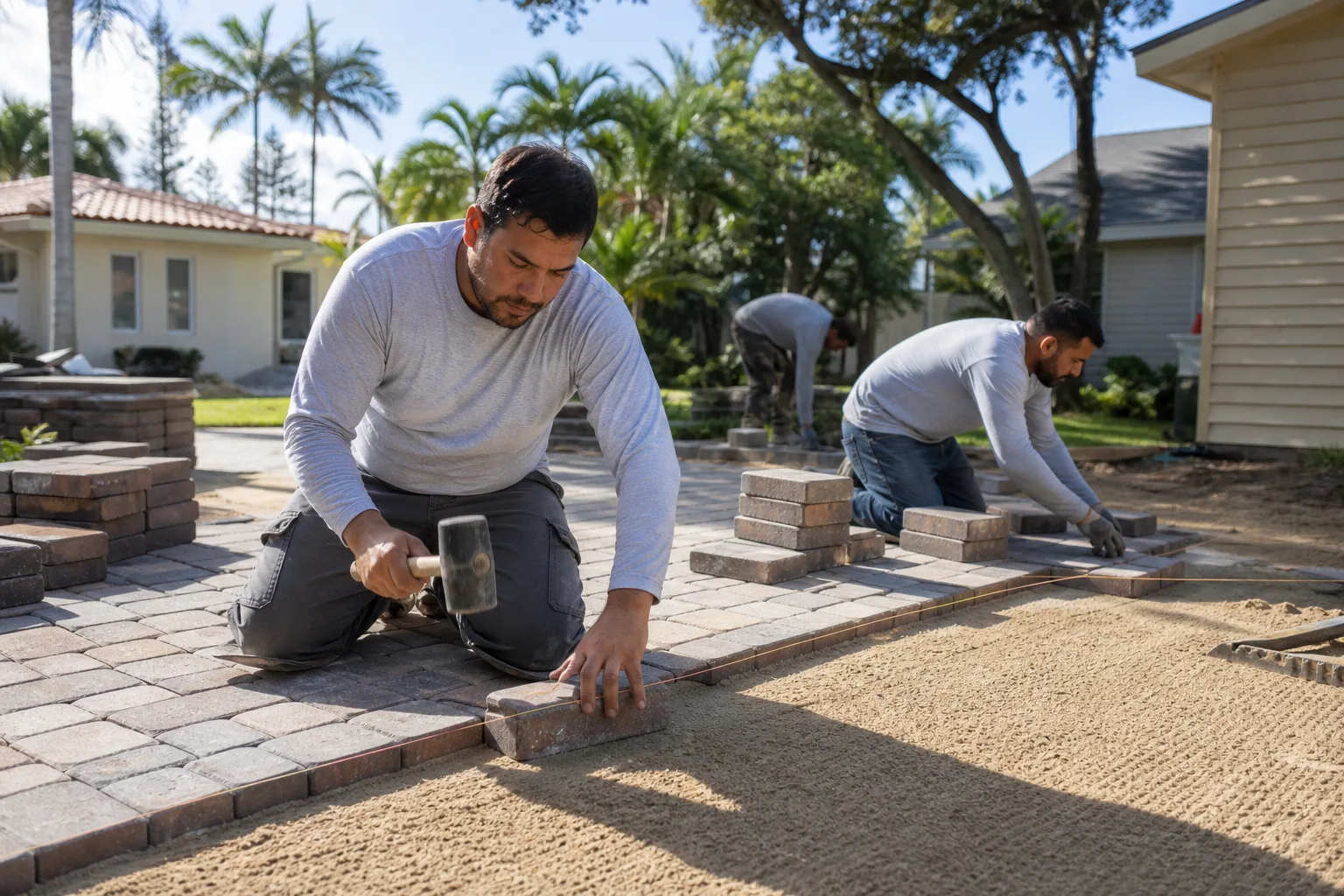
Widening joint gaps and edge paver movement are usually the first visible signs. A gap over 1/4 inch at the edge, or edge pavers that move underfoot, points to edge restraint failure and water intrusion, and the fix window is measured in weeks. Check your driveway edges every April after the spring rains. Call (833) 570-6084 for an exact quote – estimates are free.
A quarter-inch gap is the threshold where DIY re-sanding becomes a professional repair job. In Fort Worth, a gap that opens in April will be taking on rain water for the rest of the wet season, and if the edge restraint is also failing, that gap can lead to a base washout within 60 to 90 days. Call (833) 570-6084 for an exact quote – estimates are free.
Most warning signs on this list are repairable without replacing the whole driveway. Re-sanding, edge restraint replacement, and localized paver resets cover the early-stage problems; full base reconstruction is only needed when settlement covers a large area or the base was installed without compaction. Our limited photo record from each visit documents what we found and how we fixed it. Call (833) 570-6084 for an exact quote – estimates are free.
Fort Worth paver repair costs vary with scope: re-sanding alone typically runs a few hundred dollars, edge restraint replacement a bit more, and localized base reconstruction in the low four figures. The number that matters is the written quote, not the range on a page. We deliver a flat written price before work starts. Call (833) 570-6084 for an exact quote – estimates are free.
Most edge restraint repairs are a two- to three-day job: pull the failed edge units, compact or re-bed the base, install the new restraint, and re-sand and re-set the field. Schedule it in a dry week. If you’re planning a wider paver project that touches landscaping or a fence, our guide to Fence Installation in Fort Worth covers how to sequence the work so one trade doesn’t undo the other. Call (833) 570-6084 for an exact quote – estimates are free.
In Fort Worth, the summer drought cycle actually drives most of the visible warning signs – clay subgrade shrinkage opens joint gaps and loosens edge restraints. But the spring rain is when the damage gets done, because saturated base material moves under load and takes sand with it. The combination is why Fort Worth pavers need a re-sand check in both April and October. Call (833) 570-6084 for an exact quote – estimates are free.
The Bottom Line
Five visible signs on a paver driveway – widening joint gaps, rocking pavers, standing water, returning efflorescence, and edge migration – each map to a known failure mechanism with a specific repair window. The early-stage fix stays in the hundreds; the late-stage fix runs into the thousands. Measure with a 4-foot straightedge and a tape, log the results over 30 days, and let the season guide the urgency: April joint gaps are water entry points, July gaps may be drought shrinkage, and October is the recovery window to re-sand. If you’re planning anything more than a re-sand in Fort Worth, get the diagnosis in writing before anyone lifts a paver. Our team has designed these projects around what the evidence shows. You can start with a free second opinion on any written estimate – bring a competitor’s quote and we’ll review it line by line at no charge.
To see how this fits into the bigger picture of a home’s exterior, start with the Rowan Construction Group Fort Worth home page, and if your repairs touch the structure or footprint, explore our Home Additions & ADU in Fort Worth guidance as well. Call (833) 570-6084 to schedule your free estimate. Every quote is a flat written price with a written scope before anyone picks up a tool.
Written by the team at Rowan Construction Group Fort Worth.