Last updated November 18, 2026


Free written scope consultation - allowances, timeline, and change-order rules on paper before a single trade is scheduled
Driveway & Pavers Maintenance Checklist for Fort Worth Homeowners
Expansive clay soil in Tarrant County can exert up to 20,000 pounds of lateral pressure per square foot during drought-rehydration cycles. That force unseats concrete pavers from the bottom up, long before any surface crack shows. Paver driveways in Fort Worth don’t fail because of traffic. They fail because the ground underneath them swells in May and shrinks in August, and the joints, edges, and base course take the punishment. This checklist is built around that reality: how to read the early warning signs, when to re-sand, why fall sealing beats spring, and how to re-level a heaved driveway without repeating the problem eighteen months later.
Quick Answer
Fort Worth paver driveways need three maintenance actions on a reliable schedule: re-sanding polymeric joints every 2 to 3 years (kiln-dried sand every 12 to 18 months), a joint-and-edge inspection every spring and fall to catch base-course movement early, and a penetrating sealer application in September or October rather than spring. The single most important habit is checking joints and edges for creep twice a year, because edge widening is the earliest visible sign that clay soil has begun moving the base underneath your pavers.
Styles & brands we work with
- Kitchen remodeling
- Bathroom remodeling
- Home additions & ADU
- Roofing
- Windows & doors
- Driveway & pavers
- Fence
Table of Contents
- Why Fort Worth Clay Soil Is the Real Enemy of Your Pavers
- Reading Edge Creep and Joint Widening Before the Damage Shows
- Re-Sanding Intervals: Polymeric vs. Kiln-Dried Sand in North Texas
- Re-Leveling Clay-Heaved Pavers: The Correct Sequence
- Why September – October Sealing Beats Spring in Fort Worth
- Sealer Compatibility for Belgard, Techo-Bloc, and Limestone
- The Four-Season Fort Worth Paver Maintenance Calendar
- Drainage, Grading, and What Your Driveway Should Shed
Why Fort Worth Clay Soil Is the Real Enemy of Your Pavers
The black and gray clay that runs through most of Tarrant County is classified as highly expansive. It holds water like a sponge, swelling when saturated and shrinking hard when it dries. That cycle repeats every year in Fort Worth, and each cycle pushes and pulls at whatever sits on top of it. A paver driveway installed over an unprepared clay subgrade will move within a few summers regardless of how well the surface was laid.
We’ve seen this pattern repeat across neighborhoods from Arlington Heights to Wedgwood. The soil doesn’t discriminate by paver brand or price point. What protects a driveway is a properly compacted, well-drained base course (typically 4 to 6 inches of crushed aggregate over geotextile fabric in this market) and a maintenance routine that catches movement before it becomes structural.
Two things matter more in Fort Worth than in most of the country:
- Drought-rehydration swings. A dry August followed by a wet September moves clay more than steady rainfall would. The pressure builds laterally against edge restraints and vertically under the pavers.
- High UV and low summer humidity. Joint sand dries and blows out faster here than in humid climates, which lets water into the base at exactly the moment you don’t want it there.
If your driveway was installed before you bought the house and you don’t know what’s under it, that’s the first thing a Driveway & Pavers in Fort Worth assessment should establish. The surface tells you less than the base does.
Reading Edge Creep and Joint Widening Before the Damage Shows
Pavers rarely crack first. They move first. The earliest sign of base-course trouble in Fort Worth is edge creep: pavers at the perimeter of the driveway, along the garage apron or the street entrance, start to shift outward or settle slightly lower than their neighbors. Joints between those pavers widen from a uniform 1/8 inch to 1/4 inch or more. Both signals mean the base has begun to move under load or moisture.
Walk your driveway twice a year and look for these in order of severity:
- Widening perimeter joints. A joint that was tight last fall and is visibly open this spring is your first warning.
- Edge restraint separation. The paver edge restraint (the plastic or concrete lip that holds the field in place) should stay flush. If it has pulled away or lifted, the base beneath it is moving.
- Rocking or lippage. A paver that rocks underfoot or sits proud of its neighbor has lost bedding sand support. This is early-stage heave.
- Hairline cracks radiating from a joint. By the time a crack appears, the base has already failed locally. The repair is bigger than it looks.
The good news: steps one and two are cheap to correct. Steps three and four are not. Catching edge creep early is the difference between re-sanding a joint and pulling a section of driveway. We tell Fort Worth homeowners the same thing every time: the driveway is telling you what’s happening six to twelve months before it becomes expensive.
Re-Sanding Intervals: Polymeric vs. Kiln-Dried Sand in North Texas
Joint sand is the first line of defense against water reaching the base. In Fort Worth’s high-UV, low-humidity summers, joint sand degrades faster than national guidance suggests. Here’s the honest interval for each type:
- Polymeric sand: Re-sand or top off every 2 to 3 years. Polymeric sand sets harder and resists washout better, but UV exposure in Fort Worth breaks down the binder faster than in cooler climates. Check joints every spring; if sand has pulled back below the chamfer, top it off.
- Kiln-dried sand (stabilized): Re-sand every 12 to 18 months. This sand compacts well but does not set, so heavy rain and street runoff will erode it. In a Fort Worth summer with one good thunderstorm season, 12 months is realistic.
- No-sand (tight-joint) systems: Some modern pavers and slab systems are designed for narrow joints with a different fill. Confirm the manufacturer spec before adding sand; adding sand to a tight-joint system can cause staining.
Timing matters too. Re-sand in dry weather, ideally in late spring after the rainy season and before the summer heat sets in. Sand applied over damp joints won’t compact properly. If you’re re-sanding polymeric joints, the pavers need to be clean and dry for the binder to cure.
One test: pour a cup of water on a joint. If it drains straight through rather than pooling on the sand, the joint needs topping off.
Re-Leveling Clay-Heaved Pavers: The Correct Sequence
Pulling a heaved paver and re-setting it on fresh sand feels like the obvious fix. In Fort Worth clay it usually buys you 18 months before the same paver heaves again. The reason is simple: the problem isn’t at the surface, it’s in the sub-base. If you don’t address the base, you’re adjusting the symptom.
The correct sequence, in order:
- Identify the moisture source. Heave is almost always driven by water. A downspout dumping next to the driveway, a swale that collects runoff, or a broken irrigation head are the usual suspects. Fix the water first.
- Excavate to the base course. Remove the affected pavers and bedding layer, then dig down to the aggregate base. Look for soft spots, pumping fines (fine material washing up through the base), or base that’s clearly saturated.
- Check the base depth and compaction. In Fort Worth, base should be a minimum of 4 inches compacted in two lifts over geotextile fabric, more if the clay is particularly active. If the base is shallow or uncompacted, that’s the root cause.
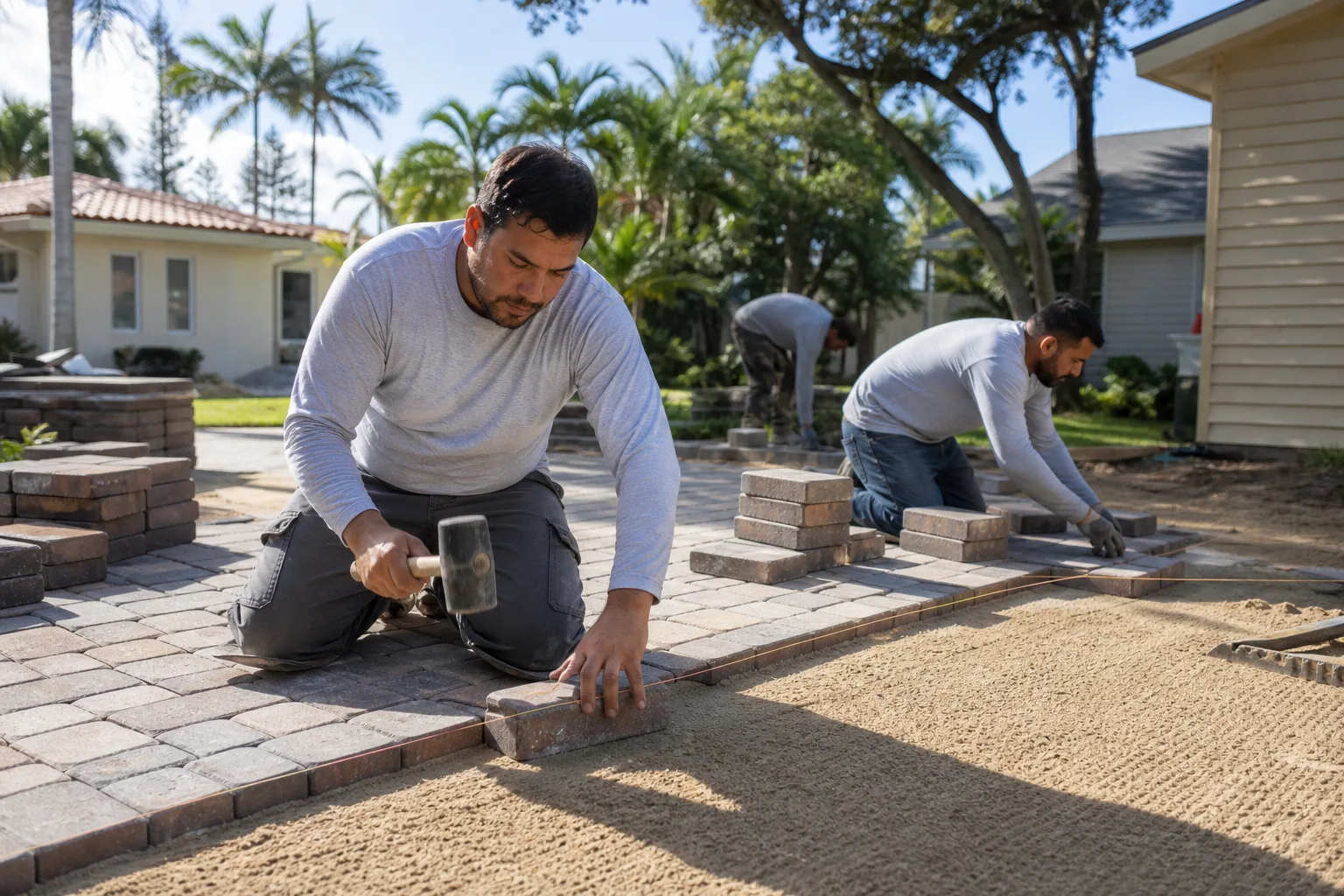
- Rebuild the base, don’t just top it. Re-compact the aggregate, re-screed fresh bedding sand to grade, then re-lay the pavers. Skipping this step is what makes the driveway heave again.
- Re-establish edge restraint and re-sand. The repair is not finished until the edge is fixed and the joints are filled.
Some Fort Worth driveways need a deeper fix: replacing a section of clay subgrade with select fill, or adding a drainage line to keep water away. That’s a bigger job, and it’s the kind of thing worth getting a written scope on before anyone starts pulling pavers. Our advice has never changed on this: get the number in writing before the work begins.
Why September – October Sealing Beats Spring in Fort Worth
Most national paver guides say “seal in spring or fall.” In Fort Worth, fall wins. Here’s why.
By September, the summer drought has pulled moisture out of the clay and the soil has stabilized. Sealing in September or October locks the surface while the ground is in a relatively contracted, stable phase. The sealer cures during mild weather with lower UV intensity, which gives it a cleaner, longer-lasting film.
Spring sealing happens when the clay is at its wettest. Sealer applied over a damp or still-moving base cures unevenly, and the first summer’s expansion cycle hits the sealer before it has fully bonded. We’ve seen spring-sealed driveways in Fort Worth haze over and wear through in a single season; fall-sealed driveways in the same neighborhood typically last two to three.
Timing specifics for this market:
- Apply penetrating sealer when daytime highs are consistently between 60°F and 80°F and no rain is forecast for 24 to 48 hours.
- Clean and re-sand before sealing, not after. Sealer over dirty joints traps moisture.
- Wait at least 48 hours after the last significant rain so the clay isn’t still moving.
If you’re not sure the joints are ready, the question to ask isn’t “when.” It’s “is the base stable?” Sealing over an unstable base is wasted money.
Sealer Compatibility for Belgard, Techo-Bloc, and Limestone
Not all pavers take the same sealer. The wrong product on a limestone driveway can darken it permanently or leave a haze that won’t buff out. Here’s the practical compatibility guide for materials common in Fort Worth:
| Paver Material | Recommended Sealer Type | What to Avoid |
|---|---|---|
| Belgard concrete pavers (most common in Fort Worth) | Penetrating siloxane or acrylic water-based | Solvent-based film formers that yellow under UV |
| Techo-Bloc concrete pavers | Water-based penetrating sealer, matte finish | High-gloss film sealer (traps moisture in the clay base) |
| Natural limestone | Penetrating sealer formulated for limestone; test patch first | Acrylics and film-forming sealers (can darken permanently) |
Two more rules that matter in Fort Worth:
- Always test-patch a 3-foot square in an inconspicuous corner and let it cure for 72 hours before committing to the full driveway.
- Carton/efflorescence sealers are worth considering on new concrete pavers, but they don’t replace a proper joint sand reset. Don’t confuse the two products.
When Rowan sources Belgard and Techo-Bloc for a Fort Worth installation, the sealer recommendation comes from the manufacturer spec sheet, not from a guess. That’s the kind of detail that separates a decade-long driveway from a three-year one.
The Four-Season Fort Worth Paver Maintenance Calendar
Here’s the schedule we hand to Fort Worth homeowners, built around Tarrant County weather patterns rather than a national template:
- March – April (spring inspection). Walk the perimeter. Check edge restraint, joint width, and lippage. Fix water sources (gutters, swales) before the rainy season. Top off sand that winter erosion carried away.
- May – June (pre-summer prep). Re-sand joints if needed. Confirm drainage is shedding water away from the house and driveway. Get any rockers addressed before the ground shrinks in summer.
- July – August (watch, don’t work). The clay is contracted and dry. Don’t seal, don’t re-sand over dry joints, don’t start a re-leveling project. Watch for new cracks, which signal a moisture problem to fix in fall.
- September – October (seal and stabilize). This is the sealing window. Re-sand first, then apply penetrating sealer. Get any heaved sections re-leveled now, while the base is stable.
- November – February (winter inspection). Check for frost heave (rare but possible in Fort Worth’s occasional hard freezes) and any new edge movement. Prep for spring.
This calendar is specific to Fort Worth’s climate. In Austin or Houston the timing shifts; in Lubbock it shifts more. Using a national calendar in Fort Worth is one of the reasons driveways fail early here.
Drainage, Grading, and What Your Driveway Should Shed
A Fort Worth paver driveway should shed water away from the house and toward the street at a slope of at least 2 percent (1/4 inch per foot). That’s the standard, and it’s easier to verify than you’d think: a 4-foot spirit level with a 1-inch block under one end gives you a quick read.
What to check:
- Low spots. Water pooling anywhere on the surface after a rain means the grade has failed. In clay soil, a low spot is a future heave.
- Downspout discharge. Downspouts that dump within 4 feet of the driveway edge are the single most common cause of edge failure we see in Fort Worth.
- Driveway-to-garage transition. The slope should run away from the garage door. If water runs toward the door, that’s a base-and-grading job, not a surface fix.
- Swales and runoff. If the driveway is the low point in a neighborhood drainage pattern, a French drain or channel drain may be the right long-term fix.
We’ve seen driveways in the Fort Worth hills west of downtown that grade beautifully and still fail because the surrounding lot drains onto them. Grading a driveway is only half the job; grading the water around it is the other half. Homeowners considering a new install or a full re-level should get a written scope that includes the drainage plan, not just the paver spec.
Common Mistakes to Avoid
- Sealing in spring because the calendar says so. Spring sealing over damp, still-active clay is the number one cause of premature sealer failure in Fort Worth. September and October are the right months here.
- Re-sanding without cleaning the joints first. Sand layered over dirt, weeds, or old polymeric residue won’t bond and will wash out within a season.
- Pulling heaved pavers without fixing the base. This is the 18-month repeat-repair trap. Address the sub-base or the heave returns.
- Ignoring the edge restraint. A loose edge restraint lets the whole field spread. Check it every spring.
- Assuming a seal fixes drainage. Sealer protects the paver surface; it does nothing for a driveway that sheds water toward the house.
- Using the wrong sealer on limestone. A film-forming acrylic on natural limestone can darken it permanently. Test-patch first.
- Skipping the twice-a-year walk-through. The cheapest repair in the world is the one caught while it’s still a joint issue. Walk the driveway in March and again in November.
See the difference
 Before
 After
 Before
 After
 Before
 After
When to Call a Professional
Some paver maintenance is homeowner work: topping off joints, checking grade, fixing a downspout. Some is not. Call a professional when you see more than three pavers rocking or heaving in the same area, when edge restraint has separated from the field, when water pools on the surface after a rain, or when a crack has appeared in the paver itself. Those all point to base-course movement, and re-leveling without addressing the base is a guaranteed repeat repair.
If you’re considering a full re-level, a new install, or you’re not sure whether that widening joint is your imagination, get a written assessment before any pavers come up. Rowan Construction Group Fort Worth offers free estimates in Fort Worth – call (833) 570-6084. Bring any written estimate from another contractor and we’ll review it line by line at no charge, part of our Rowan Construction Group Fort Worth home standing offer.
Frequently Asked Questions
Re-sand polymeric joints every 2 to 3 years and kiln-dried sand joints every 12 to 18 months. Fort Worth’s high-UV, low-humidity summers break down joint sand faster than national averages, so the shorter interval is the safer one here. If water drains through a joint instead of pooling on the sand, it’s due for a top-off.
Your pavers heave because the clay subgrade beneath the base course is expanding and contracting with moisture. Tarrant County’s expansive clay can move significantly between a wet spring and a dry August, and that movement pushes the pavers up from below. The fix isn’t at the surface; it’s in the base and in where the water goes. Call (833) 570-6084 for a free estimate on the re-leveling scope.
Fall. September and October are the right window in Fort Worth because the clay has stabilized and contracted from the summer drought, and the sealer cures during mild weather with lower UV. Spring sealing over damp, active clay is why so many Fort Worth driveways haze over in a single season.
You can, but it usually won’t last. Pulling a paver and re-setting it on fresh bedding sand without addressing the sub-base typically repeats the problem within 18 months. If you can identify and fix the moisture source and the base is sound, a single paver re-set is reasonable. If more than three pavers in one area are heaving, it’s a base problem and worth a professional assessment.
Use a water-based penetrating siloxane or acrylic sealer on Belgard concrete pavers, and a water-based penetrating matte finish on Techo-Bloc. Avoid solvent-based film formers and high-gloss products, which yellow under Fort Worth’s UV and trap moisture in the clay base. Always test-patch a 3-foot square and let it cure 72 hours before sealing the whole driveway.
Typical Fort Worth pricing runs $300 to $600 for a professional clean-and-re-sand on a standard two-car driveway, $400 to $900 for a penetrating sealer application, and $1,200 to $3,500 for a localized re-leveling job depending on the square footage and whether base repair or drainage work is included. A full driveway re-level with base correction typically runs higher. Call (833) 570-6084 for an exact written quote – estimates are free.
The Bottom Line
Fort Worth paver driveways live or die by what happens under the surface. The clay will move every year regardless of what you do; the maintenance routine is what decides whether it takes a joint out or a whole section. Walk the driveway in March and November, re-sand on the intervals above, seal in September or October rather than spring, and re-level any heaved section only after you’ve addressed the base and the water. Those habits add years to a driveway, and they’re the reason our Fence Installation in Fort Worth and Home Additions & ADU in Fort Worth crews pay the same attention to grade and drainage on every project. Every project we quote comes with a written price before work starts, and no change proceeds without a signed change order.
If you’d rather have a professional read the driveway than guess, call Rowan Construction Group Fort Worth at (833) 570-6084 for a free estimate. We’ll walk the driveway with you, tell you what we found in plain terms, and put the price in writing before anyone picks up a tool.
Written by the team at Rowan Construction Group Fort Worth.