Last updated November 18, 2026
Free written scope consultation - allowances, timeline, and change-order rules on paper before a single trade is scheduled
Driveway & Pavers Maintenance Schedule: What to Do and When
Skipping one polymeric sand re-application after a wet Fort Worth spring doesn’t just leave gaps in the joints. It starts a washout cycle that can undermine 40 square feet of base material by the following summer. Most national maintenance guides hand you a tidy spring/fall checklist copied from a climate that doesn’t exist here. Fort Worth runs on a different clock: a spring wet season that strips joint sand and a summer drought that shrinks the clay sub-base under your pavers. This guide gives you the month-by-month schedule that actually matches Fort Worth weather, plus the product specifics, sealer choices, and documentation habits that protect your investment and your warranty.
Quick Answer
In Fort Worth, paver driveway maintenance follows two climate events, not the generic spring/fall calendar: a post-rain joint sand inspection and top-up every March through May, and a drought-driven edge and crack check every June through September as the clay sub-base shrinks. A penetrating sealer goes down in the October window, and January is for freeze-thaw inspection after the handful of hard freezes Tarrant County gets each winter. Do those four things on schedule and a well-built paver driveway holds its line for decades.
Styles & brands we work with
- Kitchen remodeling
- Bathroom remodeling
- Home additions & ADU
- Roofing
- Windows & doors
- Driveway & pavers
- Fence
Table of Contents
- Why Fort Worth Pavers Need Their Own Calendar
- The Month-by-Month Fort Worth Maintenance Calendar
- Polymeric Sand: Which Brands Survive Texas Heat
- Choosing the Right Sealer for Your Paver Type
- Building a Maintenance Log That Protects Your Warranty
- Tasks That Void Manufacturer Warranties
- Common Mistakes to Avoid
- When to Call a Professional
Why Fort Worth Pavers Need Their Own Calendar
The national maintenance advice you’ll find online was written for a temperate climate with mild, evenly spaced rain. Fort Worth doesn’t work that way. We get roughly 34 inches of rain a year, but most of it lands in concentrated spring storms that dump an inch in an afternoon. That water sheets across the driveway, finds every gap in the joint sand, and blasts the fines out of the joints before draining.
Then the switch flips. By July, Fort Worth is in a drought pattern with weeks of 100-degree days and no meaningful rain. The expansive clay soil that most Fort Worth subdivisions sit on – the same clay that cracks foundations in the older neighborhoods around Ryan Place and Mistletoe Heights – shrinks as it dries. Under a paver driveway, that shrinkage pulls the base away from the edge restraints and opens hairline gaps at the perimeter.
Two events, two different failure modes, six months apart. That’s the whole reason a copied spring/fall checklist underperforms here. Your pavers don’t need the same attention in April as they do in August. The schedule below reflects what we actually see on Fort Worth driveways, street by street. For the install-side of this conversation, see our Driveway & Pavers in Fort Worth page.
The Month-by-Month Fort Worth Maintenance Calendar
This is the schedule we hand to homeowners. Print it, tape it inside a garage cabinet, and work it. Each entry is two to four hours of your own labor, or a service visit if you’d rather not get on your knees with a broom.
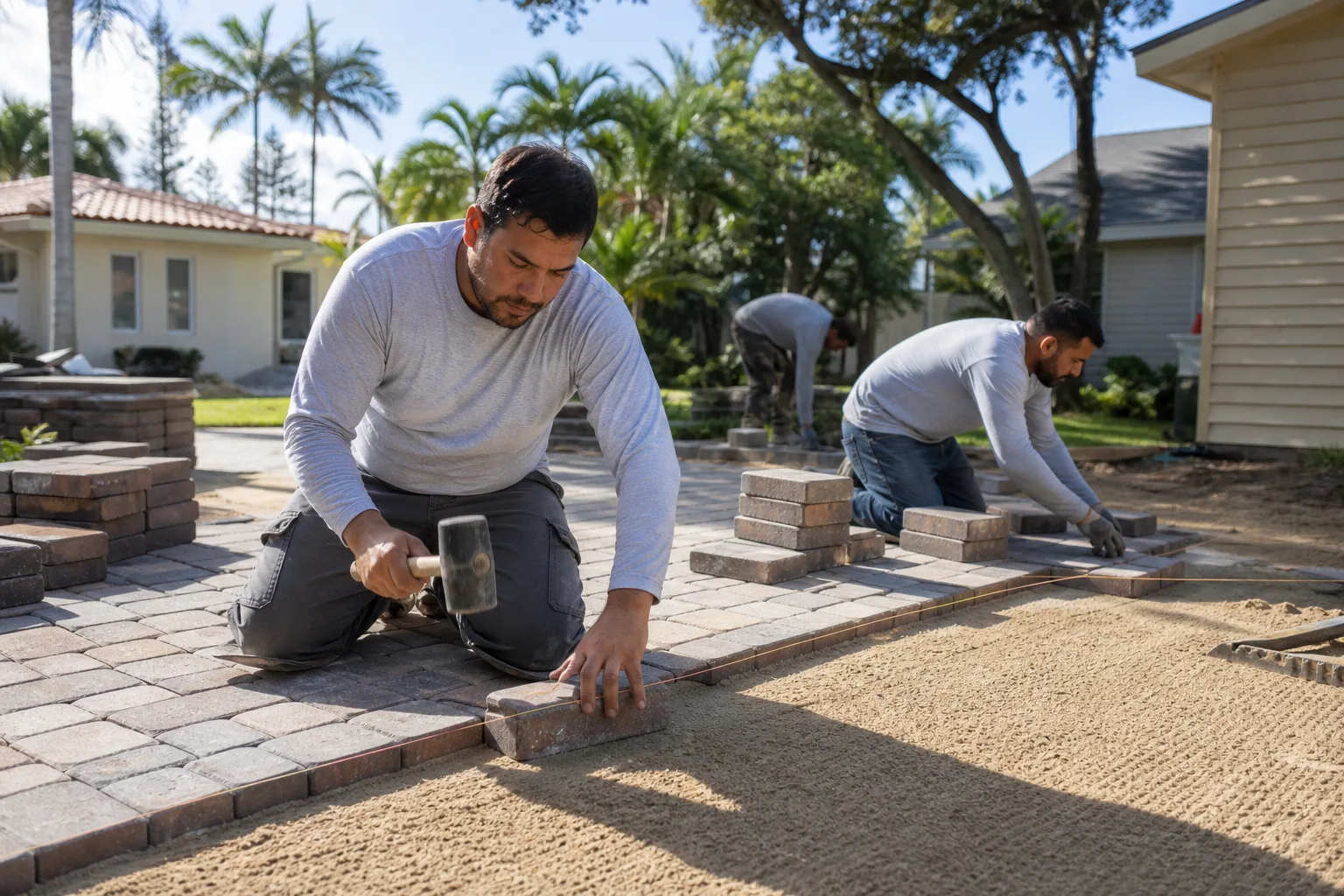
- March – post-rain joint sand check. After the first big spring storm, walk the driveway and look for joints where the sand has dropped below the chamfer (the beveled top edge of each paver). Any joint more than 1/8 inch low needs topping up. Sweep dry polymeric sand into the joints, mist lightly, and let it cure 24 hours without traffic.
- April-May – repeat the joint check after each heavy storm. This is the washout season. Keep a half bag of your original joint sand on hand so the color matches.
- June – drought edge inspection. Walk the perimeter where the driveway meets grass, curb, or garage apron. Look for gaps opening between the edge paver and the restraint. Check for any paver that rocks when you step on it. Rocking means the bedding layer has shifted, and that’s a repair, not a maintenance item.
- July-August – monitor, don’t seal. Don’t apply sealer in the heat of summer. Surface temperatures on a Fort Worth driveway hit 140 degrees in August, and most sealers flash-cure before they penetrate. Keep an eye out for cracks at the expansion joints.
- September – pre-sealer prep. Clean the surface, pull weeds from joints, and let the driveway dry for a full week of no rain before the October sealer window.
- October – sealer application window. This is the sweet spot: daytime temps in the 70s and 80s, low humidity, no rain in the forecast. Apply a penetrating sealer according to the product spec (see the sealer section below).
- November-December – leaf and debris clearing. Organic debris holds moisture against the pavers and stains light-colored surfaces. Blow or sweep weekly.
- January – freeze-thaw inspection. Fort Worth typically gets a handful of hard freezes each winter. After the last one, inspect for popped pavers, spalled edges, or joints that opened wider than they were in the fall.
- February – repair window. This is the month to schedule any repairs from the January inspection so the work is done before the spring rains return.
Polymeric Sand: Which Brands Survive Texas Heat
Polymeric sand is the joint filler that hardens after you wet it, locking pavers together and keeping weeds and water out. Not all of it holds up in Fort Worth. The failure mode here is UV degradation: cheap polymeric sand breaks down under the Texas sun within two or three seasons, turns chalky, and crumbles out of the joints.
In our experience, two brands consistently hold up to the temperature swings between a 105-degree August and a 20-degree January night:
- Techniseal HP NextGel. Rated for joint widths from 1/8 inch up to 1-1/2 inches, and its flexible formula tolerates the expansion and contraction that comes with our temperature range. It’s also less prone to haze on the paver surface when applied correctly.
- Alliance Gator Maxx. A denser, harder-set product that works well on driveways with wider joints. Holds up under the UV load but requires careful wetting – over-water it and the surface hazes.
Budget polymeric sands sold at big-box stores often skip the UV stabilizers. They cost half as much and last a third as long. On a 600-square-foot Fort Worth driveway, the difference between a two-year and a six-year sand life is roughly $200 in product vs. several days of your time every other spring. That math rarely favors the cheap bag.
Choosing the Right Sealer for Your Paver Type
Sealer is where most homeowners make the expensive mistake. The wrong sealer on the wrong paver traps moisture, turns the surface milky, and can void the manufacturer’s warranty. Match the sealer to the paver material.
- Concrete pavers (the standard gray or colored driveway block) need a penetrating acrylic sealer. It sinks into the surface and protects against UV and moisture without forming a film that can peel. Expect $0.30 to $0.60 per square foot per application in the Fort Worth market, applied every two to three years. On a 600-square-foot driveway, that’s $180 to $360 per cycle.
- Natural travertine or stone pavers need a breathable penetrating sealer that lets moisture vapor escape. Travertine is porous and holds water; a film-forming acrylic will trap it and cause spalling. Expect $0.50 to $0.90 per square foot, applied every two to four years depending on traffic.
- Clay brick pavers need a penetrating siloxane-based sealer that bonds to the surface chemistry rather than coating it. Application every three to five years is typical in Fort Worth’s climate.
One rule that cuts across all three: never apply sealer within 90 days of installation or a re-sanding, and never apply it when the pavement temperature is above 90 degrees. Both mistakes are common causes of warranty claims we see in the Fort Worth area. For more on choosing materials upfront, our home page at Rowan Construction Group Fort Worth home covers the trades and material brands we work with.
Building a Maintenance Log That Protects Your Warranty
Most paver warranties – including the ones on the Belgard and Techo-Bloc products we source – require proof that maintenance was performed. If your base fails at year four and you can’t show what you did and when, the claim goes nowhere. Keep a simple log with four data points per visit.
- Joint sand depth in the worst five joints. Measure how far the sand sits below the chamfer with a ruler or the tip of a screwdriver. Record the number in eighths of an inch. A trend line matters more than any one reading – if the sand drops a quarter inch deeper every spring, you have a washout problem, not a sand problem.
- Any paver movement, in millimeters. A paver that rocks a millimeter is a maintenance note. One that rocks three millimeters is a repair. Measure by sliding a feeler gauge or a folded piece of paper under the edge.
- Edge restraint condition. Photograph the perimeter every visit. Look for cracks in the restraint, gaps between the restraint and the paver edge, or the restraint lifting away from the concrete set.
- Weather notes for the preceding month. One line – “3 inches of rain in two storms” or “drought, no rain in 28 days” – tells a contractor whether the readings reflect normal wear or a climate event.
Add a dated photo of the full driveway each visit. Under our own documentation standard, every Rowan Construction Group visit already includes a photo record as a standard deliverable, so if we perform the maintenance, the log writes itself. If you do it yourself, your own phone camera does the same job.
Tasks That Void Manufacturer Warranties
Two common maintenance habits can cancel a warranty on your pavers. Both are worth knowing before you rent equipment.
Pressure washing above the PSI limit. Most concrete paver manufacturers cap pressure washing at around 1,500 PSI – some brands are stricter, capping at 1,200 PSI. Above that, the wand strips the factory surface treatment, opens the pores of the paver, and can blast joint sand out faster than you can replace it. Use a 15-degree or wider nozzle, keep the wand moving, and hold it at least 12 inches off the surface. If you don’t own a pressure washer with an adjustable regulator, rent one – most Fort Worth rental yards have them, and the difference in price between a weekend rental and a warranty denial is steep.
Chemical cleaners that react with the paver chemistry. Muriatic acid, the standby for concrete cleanup, is incompatible with most sealed concrete pavers – it eats the sealer and can etch the surface. Bleach-based cleaners stain travertine and stone. Stick to a pH-neutral paver cleaner, follow the dilution on the label, and spot-test on a corner paver before treating the whole driveway.
One more task that sounds harmless but isn’t: re-sanding joints with the wrong sand. If the original install used polymeric sand, replacing it with plain mason’s sand is a warranty issue on most brands because plain sand won’t bind. Use the same product the installer used, or a manufacturer-approved equivalent.
Common Mistakes to Avoid
- Waiting until summer to seal. A Fort Worth driveway surface hits 140 degrees in July. Sealer that contacts a hot surface flash-cures and leaves a white film that has to be stripped before you try again. Seal in October.
- Adding sand to a joint that’s already full. Overfilled joints push the pavers apart under freeze-thaw. Fill only to the chamfer, never above it.
- Ignoring the first rocking paver. In Fort Worth’s clay soil, a single rocking paver in June usually becomes a settled depression along the whole edge by the following spring. Fix the cause (the bedding layer) before the symptom spreads.
- Pressure washing at the highest setting “to get it really clean.” We see this on job sites around Tarrant County constantly. The driveway looks great for a week and then the joint sand is gone.
- Using bleach on light-colored pavers. It stains. It’s tempting on the cream-colored pavers that are common in newer Fort Worth subdivisions, but the stain is permanent.
- Letting the leaf litter accumulate through the fall. Wet leaves against light pavers for six weeks in a Fort Worth fall will leave a tannin stain that no sealer prevents.
- Failing to log anything. A warranty claim without records is a conversation, not a case. Log it or lose it.
When to Call a Professional
Some maintenance is homeowner work. Some is a contractor job. The line is where the material under the pavers is involved. Call a professional when you find any paver that rocks more than two millimeters, when joint sand washes out faster than you can replace it after two consecutive spring seasons, when the edge restraint has pulled away from the driveway perimeter, or when a repair from January’s freeze inspection needs to be done before spring rains. Also call if you’ve never sealed the driveway and you’re past the three-year mark – the first sealer application after a long gap needs surface prep that’s hard to do well by hand.
Rowan Construction Group Fort Worth offers free estimates in Fort Worth – call (833) 570-6084. Every estimate is a written flat price with a written scope before anyone touches the driveway, and if you’ve already got a written estimate from another contractor, bring it in – our Free Second Opinion reviews it line by line at no charge. Related work in the same trades includes Fence Installation in Fort Worth and Home Additions & ADU in Fort Worth, both of which often share a driveway washout problem with the paver work you’re doing.
See the difference
 Before
 After
 Before
 After
 Before
 After
Frequently Asked Questions
Plan on inspecting joint sand after every heavy spring storm from March through May, and topping up two to four times across that season. Full re-sanding – pulling out old sand and replacing it – is typically needed every three to five years in Fort Worth’s climate. If your joints drop more than a quarter inch deeper each spring, that’s a washout issue and needs a contractor visit, not more sand.
October is the safest sealer window in Fort Worth. Daytime temperatures sit in the 70s and 80s, humidity is dropping, and the forecast is typically dry enough to give the sealer a full 24 hours to cure. Avoid sealing from May through September – surface temperatures on a Fort Worth driveway routinely exceed the manufacturer’s upper application limit. Call (833) 570-6084 for a free estimate on a professional sealing job.
Yes, but only at or below the manufacturer’s PSI limit – usually 1,200 to 1,500 PSI, and sometimes stricter. Above that, the wand strips the factory surface treatment and can open the surface pores. Use a 15-degree or wider nozzle, keep the wand at least 12 inches off the paver, and keep it moving. If the pressure washer doesn’t have an adjustable regulator, rent one that does.
Expect $0.30 to $0.60 per square foot for a penetrating acrylic sealer on concrete pavers, and $0.50 to $0.90 per square foot for a breathable stone sealer on travertine. On a typical Fort Worth driveway of 600 to 800 square feet, that’s $180 to $720 per sealing cycle, applied every two to three years for concrete pavers. Call (833) 570-6084 for an exact quote – estimates are free.
It’s a repair. A single rocking paver more than two millimeters is a sign the bedding layer under the paver has shifted or settled, and adding sand to the joint won’t fix it. In Fort Worth’s clay soil, one rocking paver in summer usually spreads into a settled patch along the edge by the following spring. Get it looked at before the spring rains return. Call (833) 570-6084 to schedule a free inspection and estimate.
It does in Texas. Techniseal HP NextGel and Alliance Gator Maxx both hold up to the UV load and temperature swings between a 105-degree August and a 20-degree January night. Budget polymeric sands sold at big-box stores often skip UV stabilizers and break down in two to three seasons, then crumble out of the joints. On a 600-square-foot driveway, the upfront savings rarely cover the extra labor every other spring.
The Bottom Line
Fort Worth paver driveways run on a Fort Worth clock: joint sand in the spring, drought edge inspection in the summer, sealer in October, freeze-thaw inspection in January. Match your polymeric sand to a UV-stable brand, match your sealer to the paver material, and keep a four-point log so your warranty claim has a paper trail. Pressure wash below the PSI limit and never reach for muriatic acid or bleach. That’s the whole schedule, and it’s the one that actually matches our climate. If any of it feels like more than you want to handle, or if a repair is already waiting, that’s what we’re here for – we put the price in writing before anyone picks up a tool, and every Rowan Construction Group visit comes with a documented photo record as a standard deliverable. Call (833) 570-6084 for a free estimate.
Written by the team at Rowan Construction Group Fort Worth.